


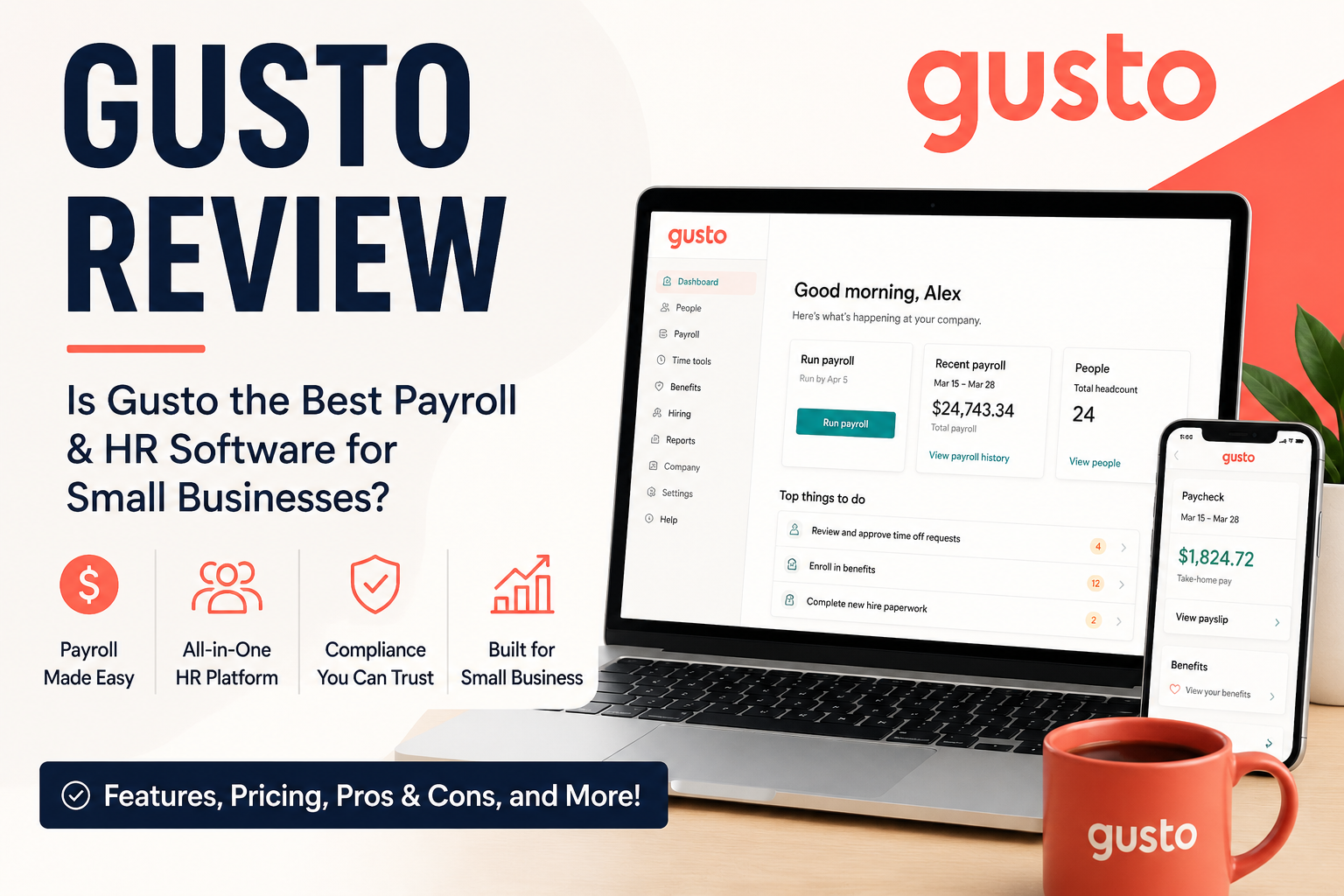
In this Gusto review, we explore how Gusto payroll software simplifies payroll, benefits, and HR for small businesses. Gusto is often touted as one of the best payroll solutions for entrepreneurs, thanks to its user-friendly interface, affordable pricing, and integrated HR tools. We will cover Gusto’s core features, pricing plans, target customers, pros and cons, user feedback, and how it stacks up against competitors like ADP, Paychex, and Rippling.
Gusto’s value comes from its all-in-one approach. It automates payroll tax filings and compliance, offers built-in benefits administration (health, 401k, 529 plans), and includes HR tools (onboarding, PTO tracking, employee self-onboarding). These features make it a compelling small business HR platform that many owners find easy to set up and use. The first 200 words introduce Gusto with keywords like “Gusto review” and “small business payroll software,” setting the stage for deeper analysis below.
Executive Summary
Gusto is a modern, cloud-based payroll and HR platform designed for small-to-mid-size businesses. It offers full-service payroll processing (with automatic tax filings), built-in benefits (health, retirement, commuter, etc.), hiring/onboarding tools, time tracking, and compliance support. Gusto’s pricing is transparent (starting at $49 base + $6 per employee per month). Users praise its ease of use and broad feature set, though customer support and advanced features (like robust compliance and scheduling) often require higher-tier plans. Overall, Gusto ranks highly in expert and user reviews (4.6/5 on G2 with 10,000+ reviews) and is recommended for small businesses seeking an integrated payroll & HR solution with transparent pricing.
Company Overview
Gusto was founded in 2012 and has grown into a popular HR/payroll platform for small businesses. According to Gusto, “Gusto is an all-in-one payroll and HR platform that helps businesses take care of their teams”. It automates payroll, taxes, and compliance, and adds HR functions like hiring, onboarding, time tracking, and benefits administration. The company has over 500,000 customers and has won awards for innovation and satisfaction (e.g. G2’s #1 payroll in 2026). Gusto’s mission is to make running payroll and managing employees as easy as possible for non-experts. This is evident in the platform’s design: 9 out of 10 customers would recommend Gusto.
Key Features of Gusto: Payroll, Benefits & HR Tools
Gusto’s main selling point is its full-service payroll. It handles unlimited pay runs (weekly, biweekly, etc.) and auto-calculates payroll taxes and filings for federal, state, and local agencies. Key payroll features include direct deposit, printed checks, and support for garnishments and multiple pay schedules. Gusto also supports paying contractors (1099) for a lower base fee.
Alongside payroll, Gusto offers employee benefits administration. Small businesses can offer health insurance, dental/vision, 401(k) retirement plans, HSAs, 529 college savings plans, commuter benefits, and more – often with no additional markup, just at cost. Gusto even acts as the licensed broker to set up plans. Other benefits include the “Gusto Wallet” (free financial benefits like 529, commuter).
For HR tools, Gusto includes hiring and onboarding features: job postings, applicant tracking, offer letters, and onboarding checklists. It provides an employee directory, employee self-onboarding (workers enter their own tax and bank info), and an org chart. Gusto also supports time tracking and PTO management: businesses can enable employee time clocks and sync hours to payroll, and set up PTO accrual policies. A recent addition is shift scheduling (in Plus/Premium plans) for work schedule creation.
Lastly, compliance support is built in. Gusto alerts you to tax registrations when hiring in new states and files W-2s/1099s. They now file the Beneficial Ownership Information Report (BOIR) for you. They offer optional compliance courses for the team (anti-harassment, HIPAA, etc.) as training. All these make Gusto attractive as a one-stop solution for payroll and HR.
Pricing and Plans
Gusto’s pricing is transparent and tiered. Plans start at $49 per month plus $6 per employee for the Simple plan, which covers single-state payroll and basic benefits. Key pricing points:
- Simple Plan: $49/month base + $6 per employee. Includes single-state payroll, tax filings, basic time off (PTO/holiday) policies.
- Plus Plan: $80/month base + $12 per employee. Adds multi-state payroll, next-day pay, time tracking, and advanced HR features.
- Premium Plan: $180/month base + $22 per employee. Includes full-service payroll with dedicated support, custom reporting, performance management tools, and direct access to certified HR experts.
- Contractor-only: $35 base + $6 per contractor (no W-2 employees).
These prices are per month, and there are no hidden fees. Gusto’s site emphasizes “No hidden fees. Cancel any time.”.
In comparison, competitors vary: ADP tends to start much higher (around $79/mo + $4–$6/emp), and Paychex Flex plans can start as low as ~$47 base + $3/emp (though actual quotes may vary). Rippling is modular: base HR is $8/emp + $35 base fee, plus add-ons (and payroll pricing is quote-only).
Gusto does run promotions from time to time (e.g. free months or discounted pricing on the first term), which makes it very competitive. The transparent tiers make it clear what features you get with each plan.
Pros and Cons
Pros:
- Affordable, transparent pricing. As noted, Gusto’s base plans are reasonably priced for the features included. The contractor-only plan ($35 base) is particularly low-cost for simple businesses.
- Full-service payroll. Unlimited runs with automatic tax filings and year-end reporting are standard across plans. Gusto also supports contractors in 120+ countries through an EOR partnership (Global Contractor Payments add-on).
- User-friendly interface. Gusto consistently ranks high for ease of use; users report running payroll quickly (some say in 10-15 minutes). The setup wizard and guided process make onboarding straightforward.
- HR tools included. Even mid-tier plans include hiring, onboarding, performance reviews, and basic time-off tracking. This makes Gusto more than just payroll software; it’s an HR platform as well.
- Strong benefits offerings. Affordable group health, 401k, and even free commuter/529 plans set Gusto apart for small businesses wanting to offer perks without high admin costs. Gusto acts as the broker with no extra fees.
- Modern, web-based. No desktop installs required; Gusto’s cloud platform works on web and mobile. Employees can self-onboard via mobile.
Cons:
- Advanced features are in higher tiers. Key tools like detailed time tracking, shift scheduling, advanced hiring (like multi-stage ATS), and extensive performance reviews are only in Plus/Premium plans. The Simple plan lacks PTO tracking and detailed HR tools.
- Customer support limitations. Lower tiers get basic email/chat support. Direct phone lines and priority support (dedicated advisor) only come with Premium. Some users report slow response times or difficulty reaching support in the Simple/Plus plans (see User Feedback below).
- Limited global scope (for now). Gusto’s payroll is US-only. The global contractor options cover 120+ countries, but full EOR (employer-of-record) services are available only in 12 countries.
- Less ideal for large/multistate operations. While Gusto handles multistate payroll, it may not scale as well as ADP Workforce Now or Rippling for very large companies with complex HR/benefits needs.
- No 24/7 support. Gusto’s live support hours are M–F 6am–6pm MST, which is good but not round-the-clock.
In short, Gusto shines for its core strengths (ease of use, payroll + basic HR) but businesses needing complex scheduling, 24/7 support, or international payroll for employees should consider those cons.
Target Customers (Who is Gusto For?)
Gusto is primarily aimed at small to mid-size U.S. businesses. According to experts, Gusto is “best for small businesses that value simplicity and transparency.”. If you have up to a few hundred employees and want a modern, all-in-one HR/payroll tool, Gusto is a great fit. Ideal customers include:
- Startups and small businesses (5–100 employees). Gusto’s ease of use makes it popular with first-time payroll users.
- Service-based businesses (consulting, agencies, retail stores, etc.). They often need basic time tracking and payroll without heavy accounting.
- Entrepreneurs/solopreneurs and SMBs hiring contractors. Gusto’s contractor plan ($35 base) and ability to pay 1099s is very appealing.
- Companies that offer benefits. Businesses looking to offer competitive benefits packages (health, 401k, commuter) will find Gusto strong. Gusto’s benefits can help attract talent at a lower cost than traditional brokers.
- Tech-savvy owners who prefer cloud solutions. Business owners who want web/mobile access and integrations with software like QuickBooks, Xero, Slack, etc., will appreciate Gusto’s modern platform. (Gusto integrates with many common accounting and time systems.)
Gusto is less ideal for enterprise-level companies or those with highly complex HR needs. Large corporations might prefer ADP, Paychex, or Rippling for their robust global payroll, extensive customization, and 24/7 support. Still, for 90% of small businesses, Gusto hits a sweet spot of features vs. simplicity.
Onboarding and Ease of Use
Getting started with Gusto is designed to be quick and user-friendly. According to Gusto, “You’re three steps away from easy, automated payroll”: sign up, add people, run payroll. In practice, new customers report that they can set up Gusto and run their first payroll in a day or two. The intuitive interface and setup wizard guide you through entering company and bank information, adding employees, and configuring pay schedules. Many tasks (like tax setup) are automatically handled by Gusto’s backend, reducing busywork.
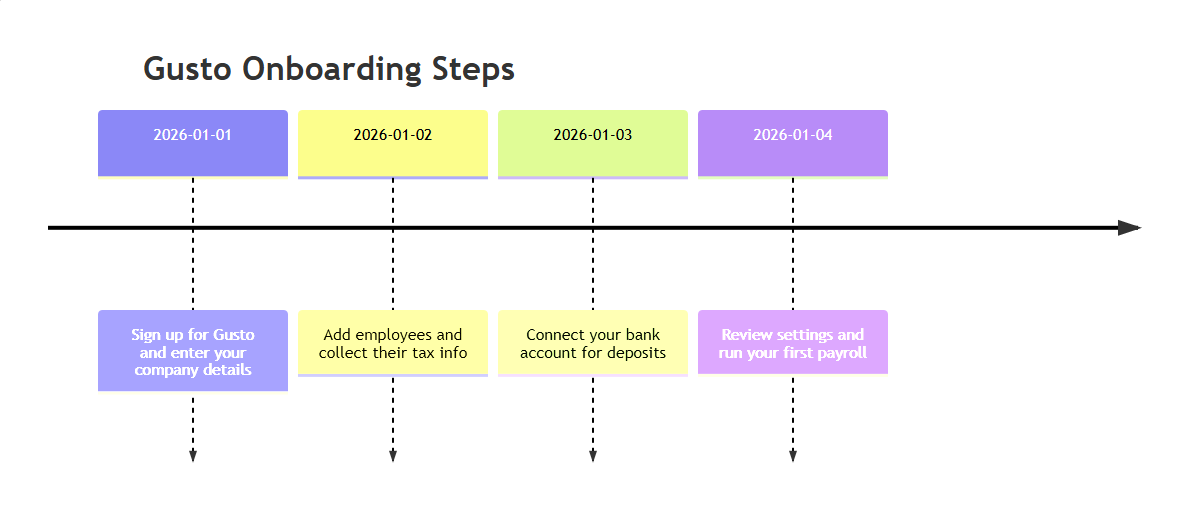
Timeline: Gusto onboarding typically involves creating an account, adding business and employee details, connecting a bank account, and then running the first payroll cycle.
The onboarding process:
- Account Setup: After entering basic business info (legal name, EIN, state registrations), Gusto helps register state tax accounts if needed (often as an add-on service).
- Add Employees: Enter or invite your employees and contractors. Employees can self-onboard by entering their W-4/tax and bank info through emailed invitation.
- Payroll Configuration: Set up pay schedules and policies (e.g. work weeks, pay dates). Gusto provides guides for entering pay rates, deductions, and time-off policies.
- Bank Account Connection: You link your business bank account securely. Gusto then uses this to pay employees and remit taxes.
- First Payroll: Gusto runs a test/pre-check; you review and approve the payroll. Then Gusto processes payments (via direct deposit or check) and files taxes.
Because Gusto’s system is largely automated, the first few payroll runs require some review time, but subsequent runs are often just a matter of a few clicks. Many users note that after the initial setup, running payroll is as simple as confirming a report. The setup help articles and customer support (email/chat during business hours) assist if any questions arise.
Overall, Gusto is very easy to use, especially compared to legacy systems. It was designed with non-experts in mind. The interface is modern and clear, with task reminders (“to-do” on payroll) and helpful wizards. One reviewer said “Payroll used to take a full day per month; now Gusto takes less than an hour”. However, a few small business owners mention that making changes to existing payroll (like adding a bonus mid-cycle) can be tricky at first.
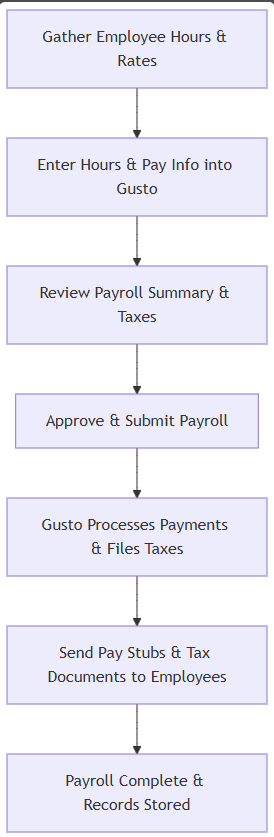
Flowchart: Simplified payroll process in Gusto – enter hours/pay data, review, submit, and Gusto handles payments and tax filings automatically.
Integrations
Gusto integrates with many popular software tools, making it easy to sync data. Common integrations include accounting software (QuickBooks Online, Xero, FreshBooks), time tracking (TSheets/QuickBooks Time, Homebase), and point-of-sale or scheduling apps (when paired via Zapier or native connectors). Gusto also integrates with applicant tracking systems and HR tools, though core offerings cover many HR needs already. While Gusto’s integration library (~150+) is smaller than Rippling’s (~650+), it includes all major partners for SMBs. If your accounting software isn’t listed, you can export payroll journals easily. Gusto’s API (for developers) lets custom apps pull payroll data if needed. Overall, integrations extend Gusto’s usefulness in managing a modern tech stack.
Customer Support
Gusto offers live customer support via phone, email, and chat (text) Monday–Friday from 6am–6pm MST. Higher-tier (Premium) customers get priority support and a dedicated advisor. According to Gusto, all support agents are based in the U.S., and during these hours you can usually get help within minutes. On G2 and Trustpilot, users give mixed feedback: many praise Gusto’s helpful guides and the support they do get, while others note that support is not 24/7 and can be hard to reach. Our sources indicate common complaints about customer service delays and difficulty resolving issues outside of basic questions. The company has acknowledged growing pains as it scales, and it does offer a robust help center and demo for self-service. Overall, support is solid, but SMBs with mission-critical needs might miss 24/7 help (unlike ADP’s around-the-clock support for larger clients).
Security and Compliance
Gusto treats security seriously. It uses bank-level encryption and multi-factor authentication to protect data. Sensitive information (tax IDs, bank details) is encrypted and never stored in plain text. Gusto is SOC 1 Type 2 and SOC 2 Type 2 audited, and complies with federal/state payroll regulations. For compliance, Gusto automatically updates tax tables and files the required reports (W-2s, 1099s, 940/941, etc.). It alerts you if any employee’s location triggers new tax requirements. For example, hiring a worker in California will prompt Gusto to register and file CA payroll taxes. Gusto’s “Premium” plan even offers direct access to certified HR experts for compliance guidance. For small businesses, this reduces risk of payroll errors – Gusto even offers a year-end tax filing guarantee (they will pay penalties if they make a tax filing error). Compared to DIY payroll, Gusto adds a significant compliance safety net.
Real User Feedback & Common Complaints
Overall user sentiment on Gusto is positive, especially on G2 (4.6/5) where many reviews highlight ease of use and the time saved on payroll and HR tasks. Users like the clean interface and comprehensive features. However, platforms like Trustpilot (which shows a lower score of 2.2/5) and Reddit contain many criticisms. The most common complaints include:
- Customer Service Issues: Many users on Trustpilot say support can be slow or unhelpful, especially for complex issues. Delays or “ticket escalations” frustrate some small business owners.
- Pricing Surprises: A few report confusion about plan pricing and unexpected fees (e.g. charges for W-2 printing if a bank account wasn’t linked in time, or higher fees for adding state tax jurisdictions).
- Payroll Errors: Some customers experience payroll glitches (incorrect tax withholdings, missed pay deadlines, or difficulty editing payroll runs once initiated). Gusto’s support usually fixes issues, but the stress of mistakes draws ire in reviews.
- Limited Communication: Owners mention that notifications (emails/alerts) aren’t always clear, so they sometimes miss deadlines if not vigilant.
- Feature Limitations: Users on the Simple plan note missing features (like shift scheduling or advanced PTO accrual rules) that require upgrading.
On the flip side, many users praise Gusto’s benefits packages (no hassles, good rates) and how it simplifies year-end reporting. One testimonial reads, “Gusto has taken away so much stress … at so many levels it helped us be confident in our people operations, particularly with onboarding and compliance.”. (This was a Gusto customer story.) In summary, Gusto tends to delight when it works smoothly, but some customers have had rocky experiences with service. These issues are not uncommon with fast-growing SaaS companies, and Gusto’s overall customer satisfaction remains high per industry surveys.
Gusto vs Competitors
| Feature / Company | Gusto | ADP (RUN) | Paychex (Flex) | Rippling |
| Starting Price | $49/mo base + $6/emp | ~ $79/mo base + ~$4–$6/emp | ~$47/mo base + ~$3–$5/emp | ~$8/emp + $35/mo base (HR modules) |
| Best For | Small businesses needing simplicity | Large enterprises (multi-state/global) | Mid to large businesses wanting payroll + benefits | Tech-forward companies needing scalable automation |
| Payroll Features | Full-service auto payroll/tax filing | Full-service, strong compliance, global payroll options | Full-service, strong mobile tools & payroll cards | Full-service with custom workflows and IT integration |
| Benefits & HR | Built-in benefits admin (health, 401k, 529), basic HR (onboarding, PTO) | Extensive benefits & retirement, robust HCM modules | Extensive (including PEO options), strong benefits integration | Comprehensive HR modules (some require add-ons) |
| Ease of Use | Very user-friendly, setup guided | More complex, enterprise-focused (steeper learning curve) | Moderately easy (dashboard more cluttered) | Feature-rich but can be complex to navigate |
| Customer Support | Weekdays 6am–6pm MST; higher tiers get priority | 24/7 support for large clients; smaller customers may experience wait times | Phone/chat 8am–8pm EST; mixed reviews on responsiveness | Business hours with live chat (fast), no 24/7 |
| User Rating (G2) | 4.6/5 (10,000+ reviews) | ~4.2/5 (RUN) | ~4.1/5 (Flex) | ~4.5/5 (Core payroll) |
Comparison table: Gusto competes well on pricing and ease of use, making it attractive for SMBs. ADP offers extensive enterprise features at higher cost, Paychex is mid-market with strong compliance, and Rippling is highly modular and tech-savvy but can be pricier.
This table shows why many small businesses choose Gusto: it offers a solid feature set at a lower price point than ADP or Paychex, and with a simpler interface. ADP and Paychex have deeper HR and compliance features, suiting larger firms, while Rippling excels in automation and large integration ecosystems (and global payroll).
Recommended Use Cases
Gusto works particularly well in scenarios such as:
- Growing startups that outgrow basic accounting software but don’t need a full HR department. Gusto can scale from 5 to 100 employees while remaining easy to manage.
- Businesses transitioning from manual payroll or QuickBooks to automated payroll. They’ll see significant time savings and fewer errors by switching to Gusto.
- Companies hiring contractors globally. Gusto’s international contractor payments add-on (with EOR partnership) simplifies paying overseas 1099s.
- Firms wanting to offer health or 401(k) benefits without dealing with brokers. Gusto bundles benefits admin at competitive rates, making it easier for small firms to provide perks.
- Entrepreneurs who prefer cloud software with mobile access. Gusto’s iOS/Android apps allow employers and employees to manage payroll tasks on the go.
If your scenario involves heavy union payroll, complex manufacturing timekeeping, or global employee payroll in many countries, you may need to evaluate ADP or Rippling. Otherwise, Gusto’s all-in-one platform is likely a very good fit.
Final Recommendation & Call to Action
After a comprehensive review, Gusto stands out as one of the best payroll and HR solutions for small businesses. Its combination of ease of use, comprehensive features (payroll+benefits+HR), and transparent pricing makes it a smart choice for entrepreneurs and SMBs. While no software is perfect—Gusto’s support and top-tier features require upgrades—many users find it dramatically simplifies payroll and compliance.
If Gusto sounds like the right fit for your business, we recommend giving it a try. Try Gusto for free and see how it streamlines your payroll and HR needs. Simply click the link below to get started (affiliate link):
Start your free Gusto trial today – make payroll painless and stay compliant, all in one easy platform.
FAQ
What is Gusto used for?
Gusto is used to manage payroll, HR, and benefits in one platform. It automates payroll processing, tax calculations and filings, benefits administration, and basic HR tasks (like onboarding and time tracking). Companies use it to save time on payroll runs and to stay compliant with tax laws.
How much does Gusto cost?
Gusto’s pricing starts at $49 per month plus $6 per employee for the Simple plan. There are higher tiers (Plus at ~$80+ and Premium at ~$180+) with more features. Contractors only: $35 base + $6/contractor. No hidden fees beyond those listed.
Is Gusto right for my business?
Gusto is ideal if you run a small or growing US-based business (usually under a few hundred employees) and want an easy-to-use payroll and HR platform. It’s especially good if you value simplicity and transparent pricing. Large corporations or businesses with very complex HR/benefit structures might consider alternatives (like ADP or Rippling) instead.
How do I cancel or change plans on Gusto?
Gusto allows you to cancel anytime online without long-term contracts. You can also upgrade or downgrade your plan (Simple/Plus/Premium) as your business needs change. Any change to your subscription can be made in the Gusto dashboard under Billing.
Does Gusto handle tax filings for me?
Yes. Gusto automatically files payroll taxes and forms for you (federal and state), including W-2s and 1099s at year-end. It also keeps you compliant with common requirements. Gusto guarantees to pay any tax penalty if it makes a filing error, giving extra peace of mind.
Sources: Data and quotes are from Gusto’s official site, expert reviews, and user review platforms. These sources provide up-to-date information on features, pricing, and user satisfaction for Gusto and its competitors.
